Full page design
Home, catalog, lot page, registration, settlement and results templates, designed as one system.
Auction operations
The website
Design and build
Grow and manage
Go to
Resources
Nothing matches that. Try a sale type, or a plan name.
An auction website design earns its name when the catalog, registration and settlement pages are built for how a sale actually runs, from the first lot listed to the last invoice sent, rather than a general business template with a product grid stretched to fit.
What it costs
Auction companies starting fresh, or replacing a general business template, who want one design system that carries every sale type they run, from estate to equipment to fine art.
Usually fits Paddle, $127 a month. Paddle carries the full design and page set; move up when you want the AI Engine answering bidders.
Signs you need it
Your current site looks like a restaurant or real estate template with a lot list pasted in.
Lot pages cannot show what your category needs, such as condition notes, equipment hours or provenance.
The site looks fine on a desktop but falls apart on the phones many bidders use.
Every new sale type means a new page someone has to design from scratch.
Most website design briefs start with a sitemap: home, about, services, contact. An auction site design starts with the sale timeline instead: a sale gets listed, lots get cataloged, bidders register, the sale runs and closes, and settlement happens. Every page in the design maps to a step in that timeline, so a visitor moves through the site the same way a sale actually moves, and nothing important is left as an afterthought bolted onto a generic template.
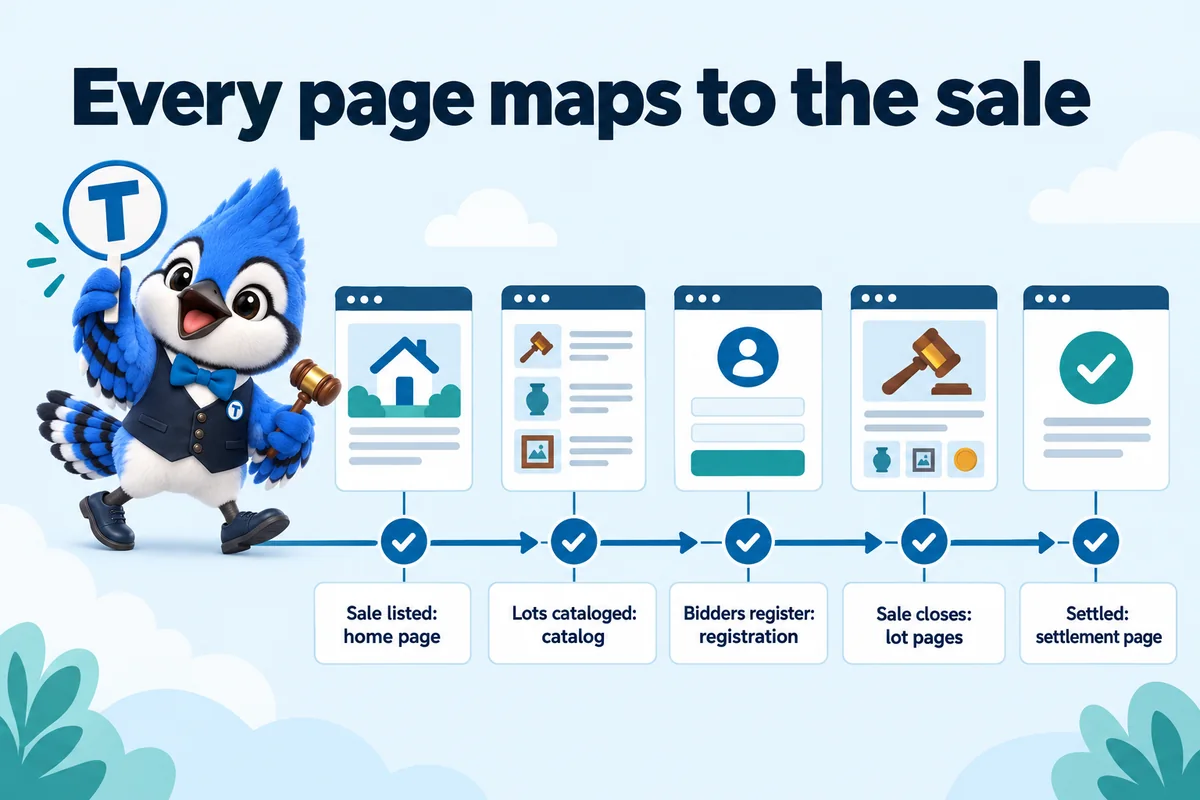
The design leans on real layout and type rather than stock photography standing in for your actual lots, because a catalog of stock images undercuts the one thing a bidder actually wants to see, which is the real item. Hero sections use your own sale content, structured clearly, rather than a generic banner image.
If you run more than one kind of sale, estate, farm equipment or fine art, for example, the design system carries one visual language across all of them while letting the lot page template flex for what each category needs to show, such as condition notes or provenance.
What is included
Home, catalog, lot page, registration, settlement and results templates, designed as one system.
Light and dark both supported, one accent color, built from your brand rather than a stock kit.
Built for a bidder checking a closing lot from a phone, not a desktop mockup resized down.
A paddle or bidder registration page designed to collect what your sale needs without losing people.
Page titles, headings and schema set up from day one, not added after launch.
Said as plainly as what is. None of these is hidden in a later invoice; they are simply not part of this service.
Want to see auction website design on your own sale? We show you a build for your sale type on a 30-minute call, with the plan that fits.
Book a 30-minute demoHow the work is done
From the first invoice to a live site in 7 to 15 days, then weekly upkeep. What you do and what we do at each step.
You: Pay the first monthly invoice.
We: Nothing else is charged. The $697 build fee does not exist yet.
You: About 15 minutes: your sale types, registration process, brand, domain and where inquiries should go.
We: Missing something? Submit anyway. The rest can follow by email or portal ticket.
You: Walk us through how a sale runs, start to settlement.
We: We reach out within one working day to book it, fill the gaps and agree the launch date. The launch clock starts on this call.
You: Review the site on a preview link and ask for changes.
We: 7 days on Paddle, 10 days on Rostrum, 15 days on Block.
You: Approve it. Only then is the build fee invoiced.
We: We point the domain, put redirects live, check speed and schema, and open your client portal.
You: Send new sales and changes from the portal.
We: 5 revisions a month within 2 to 5 working days each, researched articles published, results archived.
It is part of the monthly plan, not a separate quote. The price depends on the plan, not on the size of the job: what changes between plans is the launch window, the AI Engine and the number of articles a week. The $697 build fee is invoiced only after launch.
Extra revisions beyond the 5 included each month are $20 each, never hourly.
From clients
Honestly, the redesign was nice, but the inquiry form is what changed our day-to-day. Every submission arrives with asset category, collection area and proposed sale date filled in, which used to take us a second email to obtain. Most mornings I can prepare for the callback from the first message alone.
Got, on Paddle Inquiry form and response workflow for auction consignments
The preparation page for auction consignments works because it keeps its focus. It tells people what to have ready before we speak, without demanding everything up front. First conversations are shorter and better because of it.
Got, on Paddle Preparation guide and inquiry support for auction consignments
Terms, plainly
Four terms that protect you, and one we will not hide: once money is paid, it is not refunded. That is exactly why the build fee waits until you have approved the finished site.
The $697 build fee is invoiced only once your site is live and you have approved it. On orders placed on or before December 31, 2026 it is waived entirely.
A guaranteed standard on the pages we build and host, checked as part of every build, on every plan. Speed is never an upsell.
Cancel by email at least 2 business days before your next invoice date, counted in business hours (9 a.m. to 5 p.m. Central, Monday to Friday). Your site runs to the end of the month you paid for.
Registered in your name from day one, and transferred wherever you tell us, free, if you leave.
All sales are final. Monthly fees, the build fee and extra revisions are not refunded, including for a month you did not use. The one exception is a duplicate or incorrect charge on our side: tell us within 30 days and we correct it within 10 working days. Read the refund policy.
Standards
We design and code the site as a custom build for your sale structure. Nothing is a generic theme with your logo swapped in.
Yes, the lot page template is built to flex for different categories, such as equipment specs versus antique provenance, while the rest of the site stays one consistent design.
Yes, every page supports both light and dark themes from the same design system, with light as the default a visitor sees first.
Live in 7, 10 or 15 days depending on the plan, with the clock starting at your onboarding call rather than at purchase.
No. Send what you have, even if it is only a logo file, and we build the palette and type around it. If you have nothing, we propose a simple, readable set during onboarding.
The page structure follows proven patterns for auctions, but the palette, type, imagery, content and layout choices are built for your company, so it does not read as a copy of another client.
Yes. You review the whole site on a preview link during the build and request changes before launch, and the build fee is only invoiced once you have approved it.
It lets a bidder find a lot, understand when it closes, register and settle without calling you. That means a filterable catalog, clear lot pages, a phone-friendly registration page and a settlement page, designed as one system.
Case studies
Each one names the kind of auction house, where it sells, what we built, how long it took and what the team noticed afterwards. Business names stay private.
A live walk-through of the site you would get, in about 30 minutes. Plans from $127 a month, the $697 build fee invoiced only after launch, domain and hosting included.
Book a demoOr email and a person replies within one working day.
BidWebStudio uses the cookies below. Necessary cookies keep the site working and cannot be turned off.
Saved on this device only. Press Esc to close.