Category and status filters
Built to stay usable whether a sale has ten lots or a thousand.
Auction operations
The website
Design and build
Grow and manage
Go to
Resources
Nothing matches that. Try a sale type, or a plan name.
Auction catalog website design is the work of turning a raw lot list into a page a bidder can filter, search and scan quickly, whether the sale has ten lots or a thousand, and it is the single page most bidders spend the most time on.
What it costs
Any auction company whose catalog is the page bidders spend most of their time on, and who needs it to stay usable at ten lots or a thousand.
Usually fits Paddle, $127 a month. The catalog is the same on every plan; Paddle is enough unless you want the AI Engine or more articles.
Signs you need it
Bidders scroll a long list instead of filtering to what they came for.
Lot cards show a photo and nothing else useful.
Every sale category uses the same lot layout, whatever it needs to show.
The catalog is rebuilt by hand for every sale.
Bidders think in categories, closing times and status, not in the order lots happened to be entered. The catalog design carries filters for exactly that: category, closing time, price range where relevant, and current status, so a large sale stays navigable rather than becoming an endless scroll.
Each lot card in the catalog shows a photo, title, current status and closing time without requiring a click, so browsing the catalog itself gives a bidder most of what they need before they ever open a full lot page.
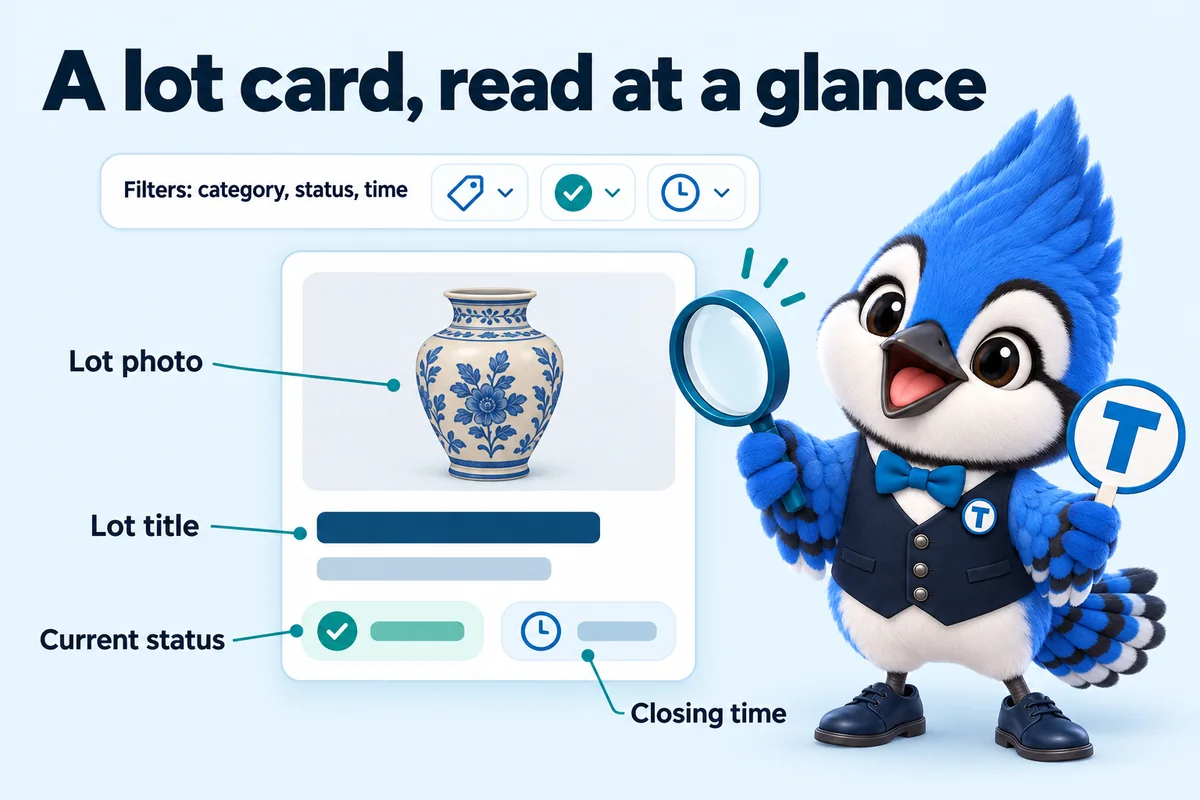
Different sale categories need different detail on the full lot page, equipment hours, provenance, condition grading, but the catalog view that lists them stays one consistent design, so a bidder browsing across categories is not learning a new layout each time.
From clients
They asked to see the questions customers genuinely ask us about auction consignments, which I respected. They identified which questions belonged on the site and we checked every answer before launch. I now share a link instead of digging through the outbox.
Got, on Paddle FAQ research and editorial review for auction consignments
The preparation page for auction consignments works because it keeps its focus. It tells people what to have ready before we speak, without demanding everything up front. First conversations are shorter and better because of it.
Got, on Paddle Preparation guide and inquiry support for auction consignments
What is included
Built to stay usable whether a sale has ten lots or a thousand.
Photo, status and closing time visible without a click.
Text search across lot titles and descriptions for larger catalogs.
Detail fields that flex per category, on one consistent catalog design.
Closed lots move to results without manual cleanup.
Said as plainly as what is. None of these is hidden in a later invoice; they are simply not part of this service.
How the work is done
From the first invoice to a live site in 7 to 15 days, then weekly upkeep. What you do and what we do at each step.
You: Pay the first monthly invoice.
We: Nothing else is charged. The $697 build fee does not exist yet.
You: About 15 minutes: your sale types, registration process, brand, domain and where inquiries should go.
We: Missing something? Submit anyway. The rest can follow by email or portal ticket.
You: Walk us through how a sale runs, start to settlement.
We: We reach out within one working day to book it, fill the gaps and agree the launch date. The launch clock starts on this call.
You: Review the site on a preview link and ask for changes.
We: 7 days on Paddle, 10 days on Rostrum, 15 days on Block.
You: Approve it. Only then is the build fee invoiced.
We: We point the domain, put redirects live, check speed and schema, and open your client portal.
You: Send new sales and changes from the portal.
We: 5 revisions a month within 2 to 5 working days each, researched articles published, results archived.
Want to see auction catalog website design on your own sale? We show you a build for your sale type on a 30-minute call, with the plan that fits.
Book a 30-minute demoIt is part of the monthly plan, not a separate quote. The price depends on the plan, not on the size of the job: what changes between plans is the launch window, the AI Engine and the number of articles a week. The $697 build fee is invoiced only after launch.
Extra revisions beyond the 5 included each month are $20 each, never hourly.
Terms, plainly
Four terms that protect you, and one we will not hide: once money is paid, it is not refunded. That is exactly why the build fee waits until you have approved the finished site.
The $697 build fee is invoiced only once your site is live and you have approved it. On orders placed on or before December 31, 2026 it is waived entirely.
A guaranteed standard on the pages we build and host, checked as part of every build, on every plan. Speed is never an upsell.
Cancel by email at least 2 business days before your next invoice date, counted in business hours (9 a.m. to 5 p.m. Central, Monday to Friday). Your site runs to the end of the month you paid for.
Registered in your name from day one, and transferred wherever you tell us, free, if you leave.
All sales are final. Monthly fees, the build fee and extra revisions are not refunded, including for a month you did not use. The one exception is a duplicate or incorrect charge on our side: tell us within 30 days and we correct it within 10 working days. Read the refund policy.
Standards
Yes, filters and search are built specifically to keep a large catalog navigable, not just a short list.
Yes, the catalog can group by active sale as well as by category, depending on how your operation runs.
Yes, status and closing time are built to reflect what your bidding platform reports, keeping the catalog accurate without manual updates.
Yes, adding a new category or lot template is a standard revision, not a redesign.
At least category, status and closing time, plus whatever your bidders search by: location for liquidation sales, period or medium for fine art, make and hours for equipment.
Photo, lot number, title, current status and time remaining at a glance, with the full detail one tap away on the lot page.
Yes. Send the spreadsheet and photos through your client portal and we publish the catalog within 2 to 5 working days.
It helps: lot and category pages with clear titles, headings and structured data give search engines more of your sale to understand, and a results archive keeps that history indexed after the sale.
Case studies
Each one names the kind of auction house, where it sells, what we built, how long it took and what the team noticed afterwards. Business names stay private.
A live walk-through of the site you would get, in about 30 minutes. Plans from $127 a month, the $697 build fee invoiced only after launch, domain and hosting included.
Book a demoOr email and a person replies within one working day.
BidWebStudio uses the cookies below. Necessary cookies keep the site working and cannot be turned off.
Saved on this device only. Press Esc to close.