Catalog pages built for lots, not blog posts
A sale catalog with filters by category, closing time and status, not a generic list of posts.
Auction operations
The website
Design and build
Grow and manage
Go to
Resources
Nothing matches that. Try a sale type, or a plan name.
Managed websites for auction companies across the US
For online and hybrid sales: we build and run the site around the bidding platform you already use, with a catalog that filters by closing time, phone-friendly paddle registration and settlement pages. Live in 7 days, from $127 a month, $697 build fee after launch.
We build and manage the website. We are not a bidding platform, an auctioneer or an escrow provider.
Mid-century walnut writing desk
Increment ladder
Example activity
 Paddle confirmed Settlement ready
Trust, up front
Three auction businesses, three different sale types, one common thread: the site finally matches how the sale actually runs.
Honestly, the redesign was nice, but the inquiry form is what changed our day-to-day. Every submission arrives with asset category, collection area and proposed sale date filled in, which used to take us a second email to obtain. Most mornings I can prepare for the callback from the first message alone.
Most of our visitors are on phones, so that is where I reviewed the new auction consignments pages. The important details sit near the top and the inquiry button is impossible to miss. The days of talking customers through the menu are over.
People used to ring just to check their auction consignments form had actually gone through. The new confirmation states what happens next and how to amend anything that needs changing. Duplicate submissions have dropped away almost completely.
The gap
Most of the friction in an online or hybrid sale is not the bidding platform. It is the website around it: a lot list nobody can filter, a registration form nobody can finish on a phone, and a closing time nobody can convert to their own time zone.
The cost of another season
An auction website that almost works does not fail loudly. It leaks, a little every sale: fewer registered bidders, more phone calls, lower prices on lots nobody saw close, and consignors who choose a competitor. None of that shows up on an invoice, which is why it runs for years.
Stop the leak before the next sale
See your catalog, registration and settlement pages rebuilt for your sale type, in a 30-minute demo. Live in as little as 7 days after onboarding.
Show me my sale on a better siteBidders who never finish registering
A first-time bidder who meets a PDF form on a phone at night is not a bidder on Saturday. Every sale starts with fewer paddles than it could have.
Lots that close under the wrong clock
A remote buyer an hour behind you reads your closing time as theirs and misses the lot. That is a lower hammer price and a phone call the office has to take.
Office hours spent answering the site
When the site cannot say when pickup is, which cards you take or how absentee bids work, your staff says it, one call and one email at a time, every sale.
Consignors who pick someone else
A seller comparing auction companies looks for past results and a clear way to consign. If your site shows neither, the company whose site does gets the estate.
Ad clicks you pay for twice
Every paid click that lands on a slow or confusing page is money spent on a visitor who leaves. You pay again to bring the next one back.
The fix
This is the mechanism, not a mood board: a catalog that filters, a registration flow that confirms a paddle, a countdown that states its time zone and a settlement page the moment a lot closes. Every plan includes the whole set, built around your bidding platform.
A sale catalog with filters by category, closing time and status, not a generic list of posts.
A registration page that collects what your sale needs before a bidder ever reaches the floor or the feed.
A visible countdown and current-bid status on catalog and lot pages, so nobody is guessing when a lot closes.
A clean page for invoices, pickup terms and past results once a sale closes.
AI agents that answer bidder questions and route consignment inquiries, without giving bidding or legal advice.
Cloudflare hosting with SSL, CDN, DDoS protection and unmetered bandwidth, included on every plan.
How a sale moves through the site
Every plan is built around this sequence. A bidder registers, is issued a paddle, watches the sale, wins a lot, settles and is archived, and the website has one specific job to do on every rung.
A bidder fills in the registration page: contact details, payment on file where your process requires it, and the terms for that sale.
The website owes: A fast, mobile-first registration page that confirms what was submitted, not a PDF nobody can finish on a phone.
Your platform confirms a paddle or bidder ID once registration is complete, and the site reflects that confirmation back.
The website owes: An on-screen confirmation the moment it happens, so a bidder is not left refreshing an inbox to know they are in.
The bidder watches the catalog and lot pages as the sale runs, checking status, current bid and time remaining.
The website owes: An accurate live status and countdown on every lot, reflecting what your bidding platform reports in real time.
A lot closes and a winning bid is recorded by your bidding platform, with the buyer premium calculated against it.
The website owes: A lot page that updates to a closed, sold status clearly, with no ambiguity about whether a bid was the winner.
The winning bidder needs to see exactly what they owe: hammer price, buyer premium, tax where it applies, and how to pay.
The website owes: A settlement page laying out the invoice, payment method and pickup or shipping window in one place, not a follow-up email.
Once settled, the sale becomes part of your public record, useful to sellers deciding whether to consign and to search engines indexing your history.
The website owes: A searchable results archive that updates automatically, without a manual rebuild after every sale.
Why BidWebStudio
Each one comes with the term that backs it. Launch windows are 7 days on Paddle, 10 days on Rostrum, 15 days on Block, counted from the onboarding call.
Every template on the site starts from a sale: catalog, lot, registration, settlement, archive. Nothing is a restaurant theme with a lot grid bolted on.
Proof Six sub-niches, each with its own page structure
We build the website around the bidding, payment and auction management system you already trust, and link or embed it. We never ask you to switch mid-season, because we are not a licensed auctioneer, bidding platform or escrow provider.
Proof No platform migration, ever
The $697 build fee is invoiced only once the site is live and you are happy with it. You see the finished site before that fee exists.
Proof Build fee invoiced after launch
5 revisions a month of any size, each completed within 2 to 5 working days. A new sale category or a new terms page is one request, not a project.
Proof Then $20 flat per extra revision, never hourly
Custom-coded pages on Cloudflare's edge, built to hold up under the traffic spike in the last minutes of a sale, and to keep paid clicks from bouncing.
Proof 90+ PageSpeed on every plan
Your domain is registered in your name, plans run month to month, and if you leave we transfer the domain at no charge.
Proof 2 business days notice to cancel
Found, quoted and fast
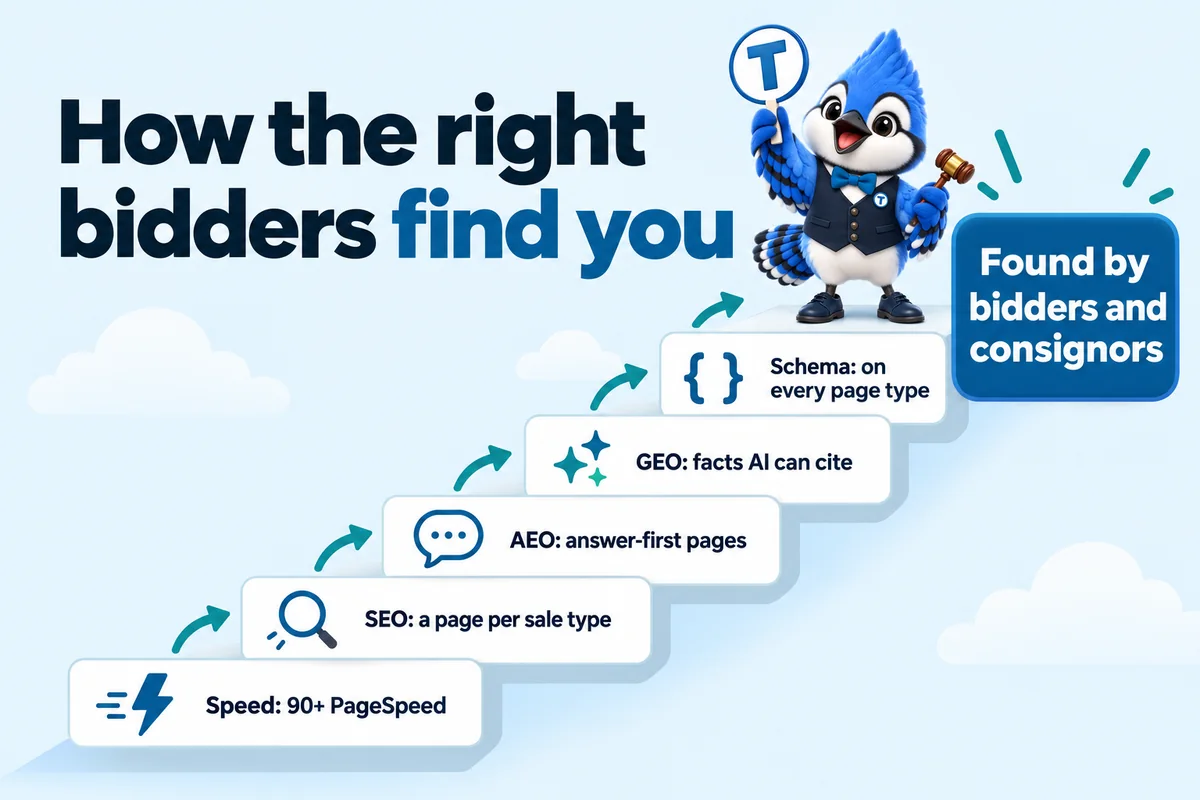
Five things every plan does so the right bidders and consignors find you, whether they search Google, ask a voice assistant or ask an AI chatbot, and so the ones you pay for through ads stay on the page.
Every page is built to load fast on a phone, with 90+ PageSpeed as the standard. That matters twice if you run ads: Google's Ads help says Quality Score includes landing page experience, and a better Quality Score can lower your cost per click. A fast page also keeps more of the visitors you already paid for, instead of losing them to a blank screen.
Clean URLs, titles, headings, sitemaps, canonicals and internal links on every page, plus a page for each sale type and each town, county or sale room you actually serve. Location pages are how an auction company starts showing up for "estate auction near me" in each area it works.
Answer engine optimization means every heading is followed by a direct answer, questions sit in visible FAQ blocks, and steps and comparisons are lists and tables. That is the shape featured snippets, voice answers and AI summaries pull from.
Generative engine optimization is about being quoted by AI assistants such as ChatGPT, Claude, Perplexity and Google AI Overviews. We keep your business facts consistent across the site, state them plainly with dates, publish an llms.txt file and leave AI crawlers allowed. No one can guarantee a mention in an AI answer; this is what makes one more likely.
We add JSON-LD structured data that tells search engines exactly what each page is: Organization or LocalBusiness for your company, Service for what you sell, FAQPage for answered questions, BreadcrumbList for the site structure, and Review markup only for reviews that are real.
Sources: Google Ads Help, "About Quality Score". More detail on speed and answer engines.
Six ways to run a sale
The same platform runs a very different sale for an estate auctioneer, a benefit gala and a farm equipment sale. Each sub-niche gets its own page structure, not a template with the name swapped.
After you order
No mystery between paying and launching. This is the whole sequence, with what you do and what we do at each step.
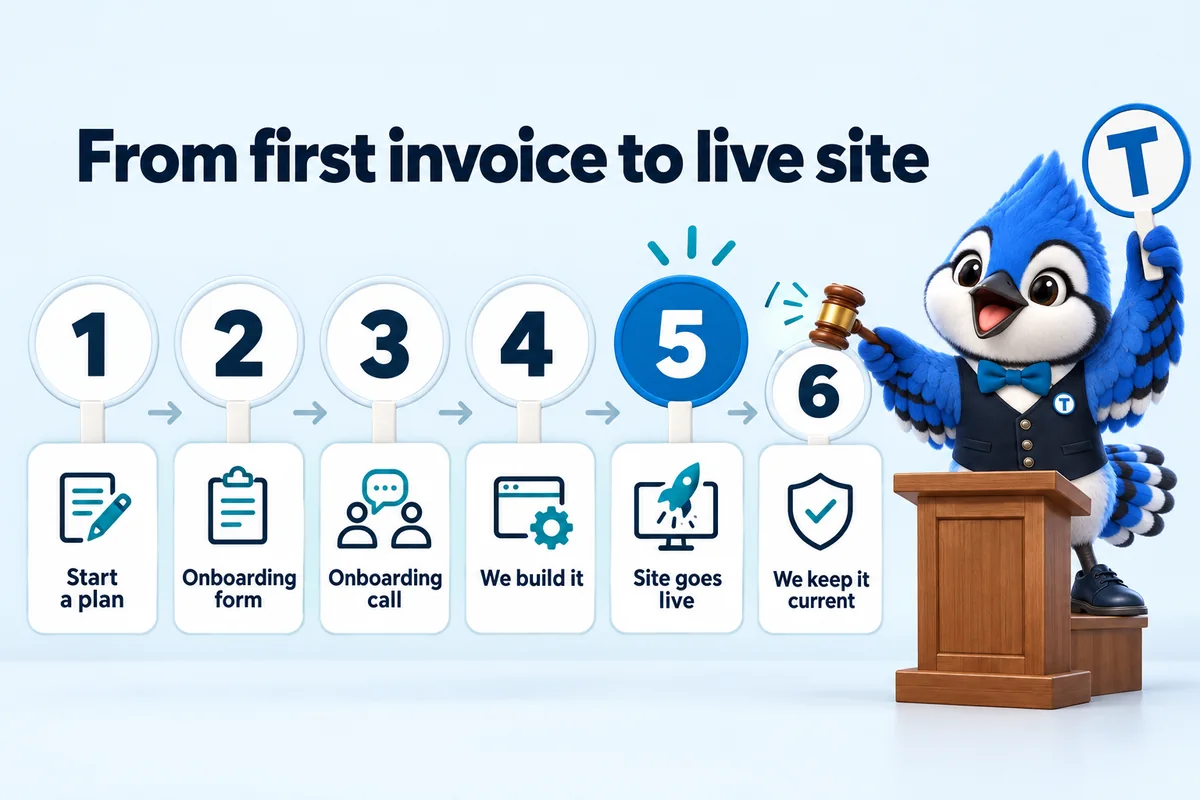
You: Pay the first monthly invoice.
We: Nothing else is charged. The $697 build fee does not exist yet.
You: About 15 minutes: your sale types, registration process, brand, domain and where inquiries should go.
We: Missing something? Submit anyway. The rest can follow by email or portal ticket.
You: Walk us through how a sale runs, start to settlement.
We: We reach out within one working day to book it, fill the gaps and agree the launch date. The launch clock starts on this call.
You: Review the site on a preview link and ask for changes.
We: 7 days on Paddle, 10 days on Rostrum, 15 days on Block.
You: Approve it. Only then is the build fee invoiced.
We: We point the domain, put redirects live, check speed and schema, and open your client portal.
You: Send new sales and changes from the portal.
We: 5 revisions a month within 2 to 5 working days each, researched articles published, results archived.
Design, build, grow
Design, development, redesign, search and multi-location work all sit inside the monthly fee. Nothing here is billed as a project on top.
From the sale room
Drag the cards, or use the arrows. Each one names the business, where it sells and the pages it got, from an agricultural equipment house in California to a stamp and coin specialist in Nevada.
Case studies
Each one names the kind of auction house, where it sells, what we built, how long it took and what the team noticed afterwards. Business names stay private.
Worked example
We will publish client results as clients agree to share them. Until then, here is what the plan itself puts on your site in twelve months, multiplied out from the published terms. These are outputs we commit to, not outcomes we are promising.
Plan Paddle
AI Engine available from the next plan up
Plan Rostrum
AI Engine answering bidder questions all year
Plan Block
AI Engine answering bidder questions all year
Worked example: 52 weeks times articles per week, 12 months times included revisions. Every sale's catalog, settlement page and results archive updates sit on top of these, as part of the weekly service.
Six months after launch
This is what the change looks like in practice: fewer calls, fewer missed closings, and a site that keeps selling your company to consignors between sales.
Monday
You send next Saturday's lot list and photos from the client portal. By midweek the catalog is up, filtered by category and closing time, and the sale is on the home page.
Wednesday night
A bidder two states away registers on her phone at 11 p.m., gets a paddle confirmation on screen, and never calls the office. Her question about pickup was already answered on the terms page.
Saturday, closing
Traffic peaks in the last minutes. The lot pages stay quick, every countdown shows its time zone, and nobody emails to ask whether lot 27 has closed.
The next Tuesday
Settlement is on one page, results go into the archive, and a family deciding which auction company to call for their parents' estate finds six months of your sale history before they find anyone else's.

The value case
What is one extra consignment worth to your company, in commission and buyer premium? Set that against the full first-year cost below. That comparison, made with your own numbers, is the whole value case. We will not guess your figure for you.
What the monthly fee replaces

First year, all in
| Plan | Monthly | Year one | Per week |
|---|---|---|---|
| Paddle | $127 | $2,221 | $43 |
| Rostrum | $267* | $3,901 | $75 |
| Block | $647* | $8,461 | $163 |
Year one is twelve monthly fees plus the $697 build fee, which is invoiced only after launch. Year two onward is the monthly fee alone. *Plus AI usage, billed at cost in arrears. Ordering on or before December 31, 2026? The build fee is waived entirely, so year one is the twelve monthly fees alone.
See what each plan includesWhat is in each plan
The page set, hosting, SEO and revisions are identical across the three plans. Rostrum adds the AI Engine and Block adds the Content Engine on top. Select any feature to read what it does.
Not included, on any plan
Terms, plainly
Four terms that protect you, and one we will not hide: once money is paid, it is not refunded. That is exactly why the build fee waits until you have approved the finished site.
The $697 build fee is invoiced only once your site is live and you have approved it. On orders placed on or before December 31, 2026 it is waived entirely.
A guaranteed standard on the pages we build and host, checked as part of every build, on every plan. Speed is never an upsell.
Cancel by email at least 2 business days before your next invoice date, counted in business hours (9 a.m. to 5 p.m. Central, Monday to Friday). Your site runs to the end of the month you paid for.
Registered in your name from day one, and transferred wherever you tell us, free, if you leave.
All sales are final. Monthly fees, the build fee and extra revisions are not refunded, including for a month you did not use. The one exception is a duplicate or incorrect charge on our side: tell us within 30 days and we correct it within 10 working days. Read the refund policy.
Where and who
We work with auction companies across the US, remotely, from the first call to launch. Farm and equipment sales in Iowa, Nebraska and Kansas, estate sales in Texas, Ohio and Pennsylvania, benefit galas in California and Florida: the sale types change by region, the website problems do not.
A few of the states we build for
Selling across Eastern, Central, Mountain and Pacific time? Every closing time on your site states its time zone, so a bidder in another state never reads your clock as theirs.
The build team
Designs and codes your catalog, lot, registration and settlement pages, and makes every revision you send.
The editorial team
Researches and writes your weekly articles, cites every figure, and never gives licensing, escrow or legal advice.
The support desk
Answers your client portal tickets and email. A person replies within one working day; revisions land within 2 to 5 working days.
Pages your site launches with
Built with the Americans with Disabilities Act (ADA), state privacy laws such as the California Consumer Privacy Act (CCPA) and the Telephone Consumer Protection Act (TCPA) in mind, to help you meet them. It is not legal advice, and we are not a licensed auctioneer, bidding platform or escrow provider.
Fair questions
Plans start at $127 a month, so the real alternatives are doing it yourself, a freelancer, or the platforms you already use. Here is the honest answer to each, and a full sourced comparison behind every one.
"I could build it myself on Wix or Squarespace."
You could, and for a simple site with a few sales a year it may be enough. The catch is every week after launch: a new catalog, new closing times, new results. On a builder that work is yours.
Wix vs a managed site"My bidding platform already gives me a catalog page."
Keep it. That page runs the bidding. Your own site is what ranks for your name and your area, explains registration and pickup, shows your history to consignors, and sends bidders into that catalog.
How we build around your platform"My nephew or a freelancer can do it cheaper."
The first build, maybe. Then ask who updates it on the Thursday before a sale, who holds the domain, and what each change costs. A managed plan prices the upkeep in.
Freelancer vs managed"We already run everything in HighLevel."
Good, keep running it. HighLevel carries your CRM, texting and automations; the auction site carries the catalog and search, and sends every inquiry into HighLevel.
HighLevel builder vs managedSee all ten comparisons, including WordPress, Webflow and GoDaddy
Next sale, better site
A 30-minute walk-through of a build for your kind of sale, on your screen. Plans from $127 a month, the $697 build fee invoiced only after launch, live in 7 days.
BidWebStudio uses the cookies below. Necessary cookies keep the site working and cannot be turned off.
Saved on this device only. Press Esc to close.